Get medical help straight away if you notice sudden hearing loss in one or both ears, hearing loss with dizziness, or ear pain or discharge. Sudden hearing loss is a medical emergency, and treatment works best within the first few days.
How this hearing test works
This is a pure-tone hearing test, the same type audiologists use. It finds your hearing threshold, the quietest beep you can hear, at each pitch in each ear, then plots the results on an audiogram.
- Headphone check. You confirm that “Right” plays in your right ear and “Left” in your left. Swapped sides would put each result on the wrong ear.
- Volume setting. A 1 kHz reference tone plays at a fixed digital level and you set your device volume so it sounds soft but clear. This anchors the scale. Changing the volume afterwards would shift every result.
- Threshold search. Beeps play at random moments. Press the button (or Space) whenever you hear them. After each beep you hear, the next one is 10 dB quieter. After each one you miss, it’s 5 dB louder. Your threshold is the quietest level you hear on two out of three tries on the way up. This is the modified Hughson–Westlake method used in clinics.
- Checks for reliability. 1 kHz is tested twice and silent trials are mixed in, so you can see whether your responses were consistent.
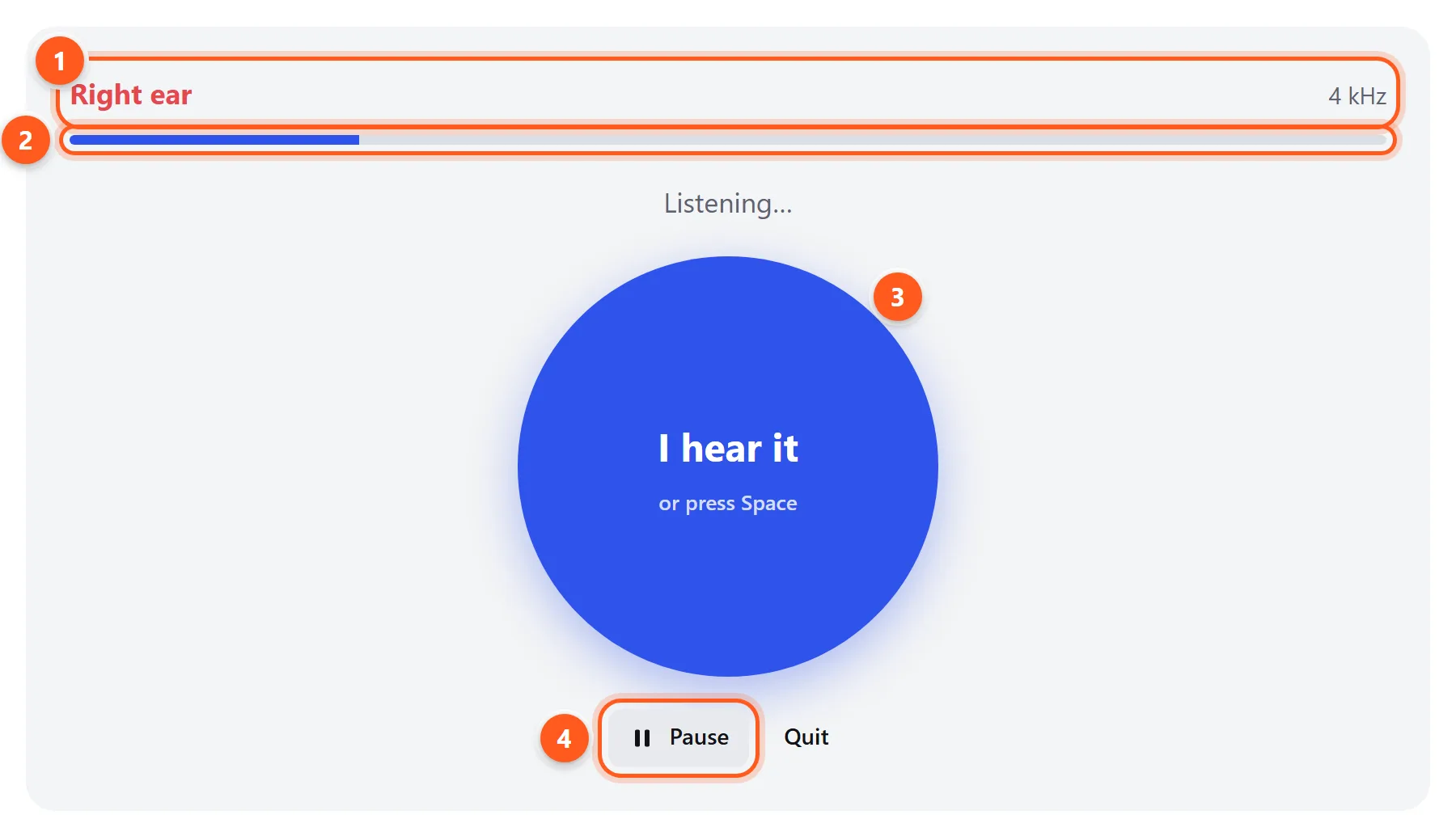
- The ear and pitch being tested. The right ear goes first, then the left.
- Progress through the test.
- Press whenever you hear beeps, even faint ones, or press Space. The button doesn’t tell you whether a beep was played, so it can’t bias you.
- Pause anytime. A beep interrupted by a pause is simply repeated.
The beeps come in groups of three short pulses. Pulsed tones are easier to notice near your threshold than one long tone, especially if you have tinnitus. Here’s what a test beep sounds like at a comfortable level:
How to read your audiogram
An audiogram is a chart of the quietest sounds you can hear. It looks upside down at first: better hearing is at the top.
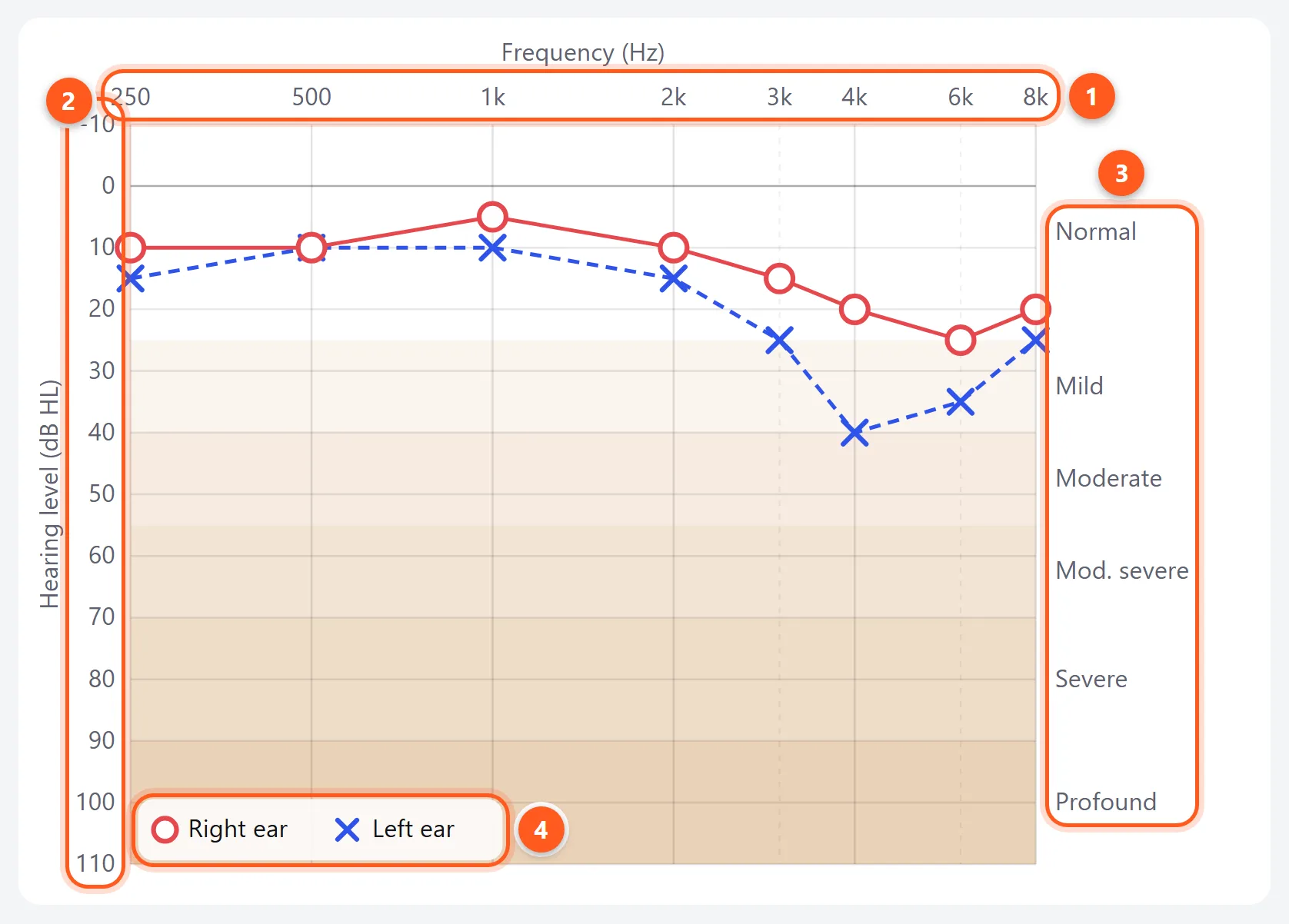
- Frequency (pitch) from low (250 Hz, a deep hum) on the left to high (8 kHz, a sharp whistle) on the right. Speech mostly sits between 500 Hz and 4 kHz.
- Hearing level (dB HL). Each line is 10 dB quieter towards the top. Points lower on the chart mean you needed a louder tone to hear it.
- Shaded bands show the degree of hearing loss. Everything in the white area at the top (25 dB or better) is normal.
- Symbols: red O for the right ear and blue X for the left, the standard audiogram symbols.
In this example, the right ear is normal everywhere. The left ear is normal up to 2 kHz, then dips to 40 dB at 4 kHz and recovers at 8 kHz. That’s the noise-damage pattern described below. Below the chart, the test also shows each ear’s pure-tone average (the average of 500 Hz, 1, 2 and 4 kHz), the single number most often used to describe the hearing in an ear.
Example audiograms
Degrees of hearing loss
| Hearing level | Degree | What it’s like |
|---|---|---|
| −10 to 25 dB HL | Normal | You hear soft speech and whispers without trouble. |
| 26–40 dB HL | Mild | Soft speech, whispers and speech in noisy places are hard to follow. Many people don’t notice it themselves. |
| 41–55 dB HL | Moderate | Normal conversation is hard to follow without hearing aids. TV volume goes up. |
| 56–70 dB HL | Moderately severe | Speech must be loud to be heard. Group conversations are very difficult. |
| 71–90 dB HL | Severe | Only very loud speech is heard. Powerful hearing aids or cochlear implants help. |
| 91 dB HL or more | Profound | Speech isn’t heard without amplification. Relies on lip reading, sign language or cochlear implants. |
These are the categories commonly used in the United States (based on the ASHA scale). The World Health Organization uses slightly different cut-offs, so a 25 dB result counts as normal on both, but the WHO starts “mild” at 20 dB.
When to see an audiologist
- Any result outside the normal range in this test, especially if it repeats on a second try.
- A difference of more than 15 dB between your ears. Unequal hearing loss can have medical causes that should be ruled out.
- You often ask people to repeat themselves, struggle in restaurants, or turn the TV up more than others like.
- Ringing, buzzing or hissing in your ears (tinnitus) that doesn’t go away.
- A feeling of fullness in the ear, dizziness, or ear pain.
In the US you can see an audiologist without a referral in most cases, and many offer free hearing screenings. Since 2022, over-the-counter hearing aids are also available without a prescription for adults with perceived mild to moderate hearing loss, but a professional test is still the best way to choose the right help.
Limits of an online hearing test
- Unknown sound level. The test can’t measure your headphones’ output. The volume step sets the scale, so a consistent bias in how you set it shifts all results up or down. The shape of your audiogram and the difference between your ears are more reliable than the absolute numbers.
- Headphone frequency response. Cheap earbuds can be 10 dB or more weaker at 250 Hz or 8 kHz, which looks like hearing loss at those pitches. A good seal matters most for low tones.
- Background noise masks low frequencies first. Test at a quiet time of day.
- No bone-conduction test. Audiologists also test with a vibrator behind the ear to tell whether a loss is in the outer/middle ear (often treatable) or the inner ear. That isn’t possible online.
How to protect your hearing
- Follow the 60/60 rule with headphones: no more than 60% volume for no more than 60 minutes at a time.
- Wear earplugs at concerts, clubs, sports events and when using power tools or lawn mowers. Foam plugs cost cents, and musician’s earplugs keep music sounding natural.
- Use noise-cancelling headphones on planes, trains and in noisy offices so you don’t turn the volume up to drown out the noise.
- Know your levels. Sounds above 85 dB can damage hearing with long exposure. Measure your surroundings with the decibel meter.
- Give your ears a break after loud events. Ringing or muffled hearing afterwards is a sign of temporary damage, and repeated damage becomes permanent.
Want to know how high you can hear? The mosquito tone test checks frequencies up to 20 kHz, above what a standard hearing test covers.