How the perfect pitch test works
- Choose your settings. 24 notes give a reliable score. One octave uses notes from middle C up. Five octaves spreads notes from C2 to B6 and is harder. Pure tone removes the piano’s sound color, which is the strictest test.
- Listen and click the note you heard on the keyboard, or use your computer keyboard (A = C, W = C♯, S = D, E = D♯, D = E, F = F, T = F♯, G = G, Y = G♯, H = A, U = A♯, J = B). You can replay the note before answering.
- See the answer instantly. The correct key turns green, and your answer red if it was wrong.
- Between notes, you hear a short burst of random tones. This “pitch eraser” stops you from working out each note from the previous one. That would test relative pitch instead.
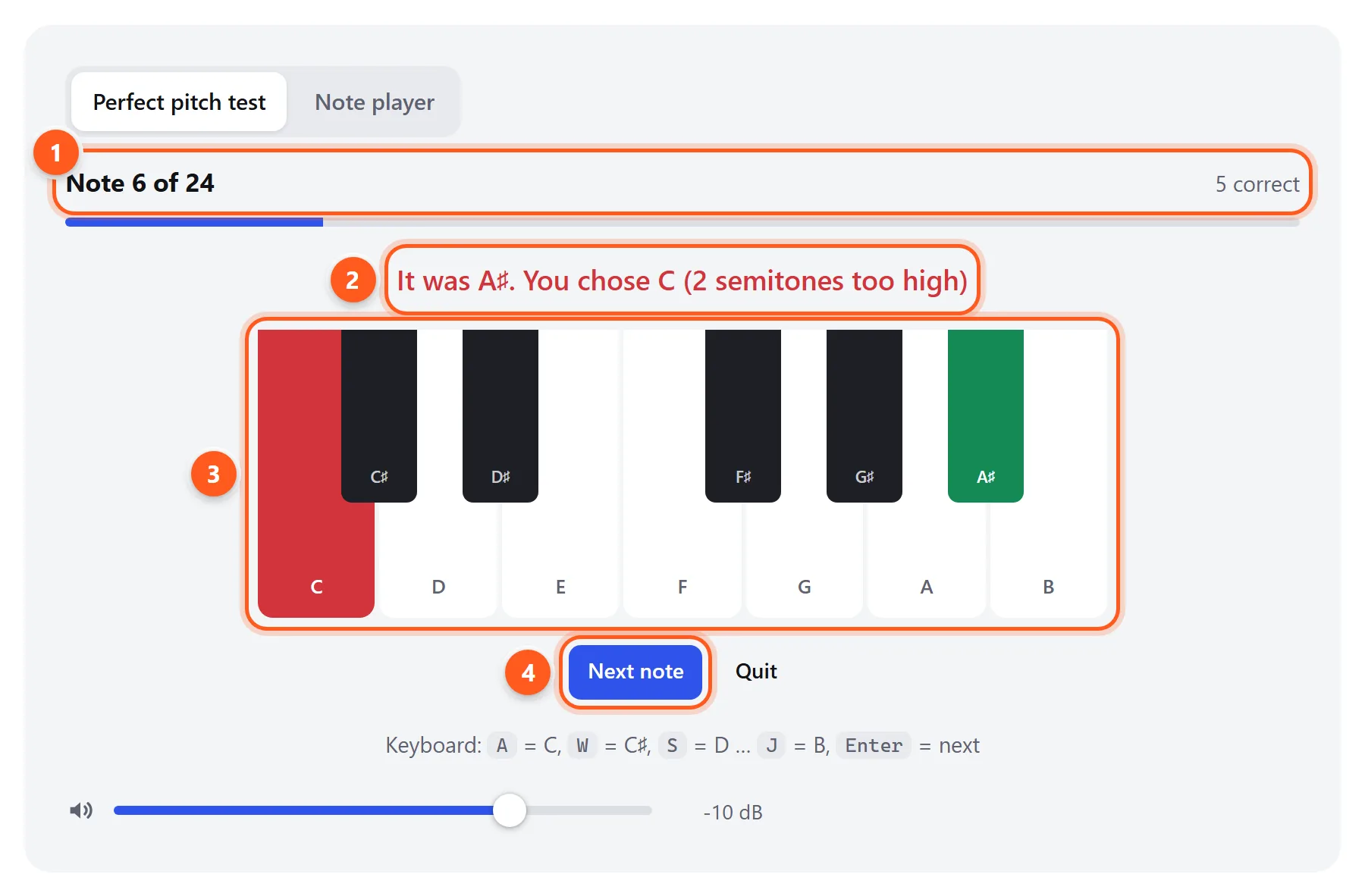
- Your progress and running score.
- Feedback: the right answer, and how far off you were in semitones.
- The correct note is green and your answer is red. Every note is equally likely, and each appears equally often.
- The next note starts automatically after a moment. Press Next note or Enter to go straight on. Before you answer, a Replay note button lets you hear the note again.
What is perfect pitch?
Perfect pitch, or absolute pitch, is the ability to name or sing a musical note without hearing a reference note first. Someone with perfect pitch hears a car horn and knows it’s an F, the way most people see a color and know it’s red.
It’s rare. Estimates suggest fewer than 1 in 1,000 people in North America and Europe have it. It’s far more common among professional musicians who started lessons in early childhood, and among speakers of tonal languages such as Mandarin, Cantonese and Vietnamese, where pitch changes the meaning of words.
Perfect pitch vs. relative pitch
| Perfect (absolute) pitch | Relative pitch | |
|---|---|---|
| What it is | Naming a note on its own | Hearing the distance (interval) between notes |
| Example | “That beep is an A♭.” | “If that’s C, the next note is the E above it.” |
| How common | Under 0.1% of people | Can be learned by almost anyone |
| Learnable | Mostly in early childhood | Yes, at any age, with ear training |
| Useful for | Transcribing, identifying keys instantly | Playing by ear, singing in tune, improvising, transposing |
Perfect pitch isn’t a measure of musical talent. Many great composers and performers don’t have it, and it can even be a nuisance: people with absolute pitch can find transposed music or out-of-tune recordings uncomfortable.
Can you learn perfect pitch?
The honest answer: true absolute pitch is very hard to acquire as an adult. Most people who have it started music before about age 6, which points to a critical period in development. Some adults improve their note-naming a lot with daily practice, and a few reach high accuracy, but most don’t reach the near-instant, effortless naming of people who developed it as children.
What you can build at any age is strong pitch memory: anchoring one or two reference notes, like the A of an orchestra tuning or the lowest string of your guitar, and recalling them reliably. Combined with good relative pitch, that gets you most of the practical benefit.
What does a C note sound like?
Press play to hear each C on the piano as a pure tone. Each C is exactly double the frequency of the one below it, one octave higher. The Note player tab above plays any note with a piano sound.
| Note | Frequency | Where you hear it | Listen |
|---|---|---|---|
| C1 | 32.70 Hz | The lowest C on a piano, felt as much as heard | |
| C2 | 65.41 Hz | Low C of the cello (open string) | |
| C3 | 130.81 Hz | Low C of the viola; a typical male speaking pitch | |
| C4 | 261.63 Hz | Middle C, in the center of the piano keyboard | |
| C5 | 523.25 Hz | Tenor high C; the C above middle C | |
| C6 | 1046.50 Hz | Soprano high C | |
| C7 | 2093.00 Hz | Near the top of the flute and piccolo range | |
| C8 | 4186.01 Hz | Highest note on a standard 88-key piano |
Middle C (C4) = 261.63 Hz in standard concert tuning (A4 = 440 Hz). It sits in the middle of the piano, just left of the two black keys near the keyboard’s center, and is the note between the treble and bass staves in sheet music. On a guitar, it’s the 1st fret of the B string. Very low notes like C1 may be inaudible on phone or laptop speakers.
Tips for a fair result
- Don’t hum or sing a reference before the test, and don’t look at an instrument. That turns it into a relative pitch test.
- Answer quickly. People with absolute pitch name notes in about a second. Long deliberation usually means you’re working it out some other way.
- Take the test twice on different days. Pitch memory varies with tiredness.
- Check the per-note chart. Many people with partial absolute pitch do best on white keys, or on the note their instrument tunes to.