Keep the volume moderate. High tones near the limit of your hearing can be loud enough to harm your ears before they sound loud. Never turn the volume up to hunt for a tone you can’t hear.
How to take the hearing age test
- Use headphones if you can. Wired headphones are best. Phone and laptop speakers often can’t play above 15 kHz.
- Set a comfortable volume on a normal sound first, for example the 8 kHz example below, then leave it.
- Press Start. Each tone plays for about 1.5 seconds. Answer Yes or No, or press Y or N. Use Play again if you’re unsure.
- The test ends at the first tone you can’t hear. Your result is the highest tone you heard, with the age group that can typically hear it.
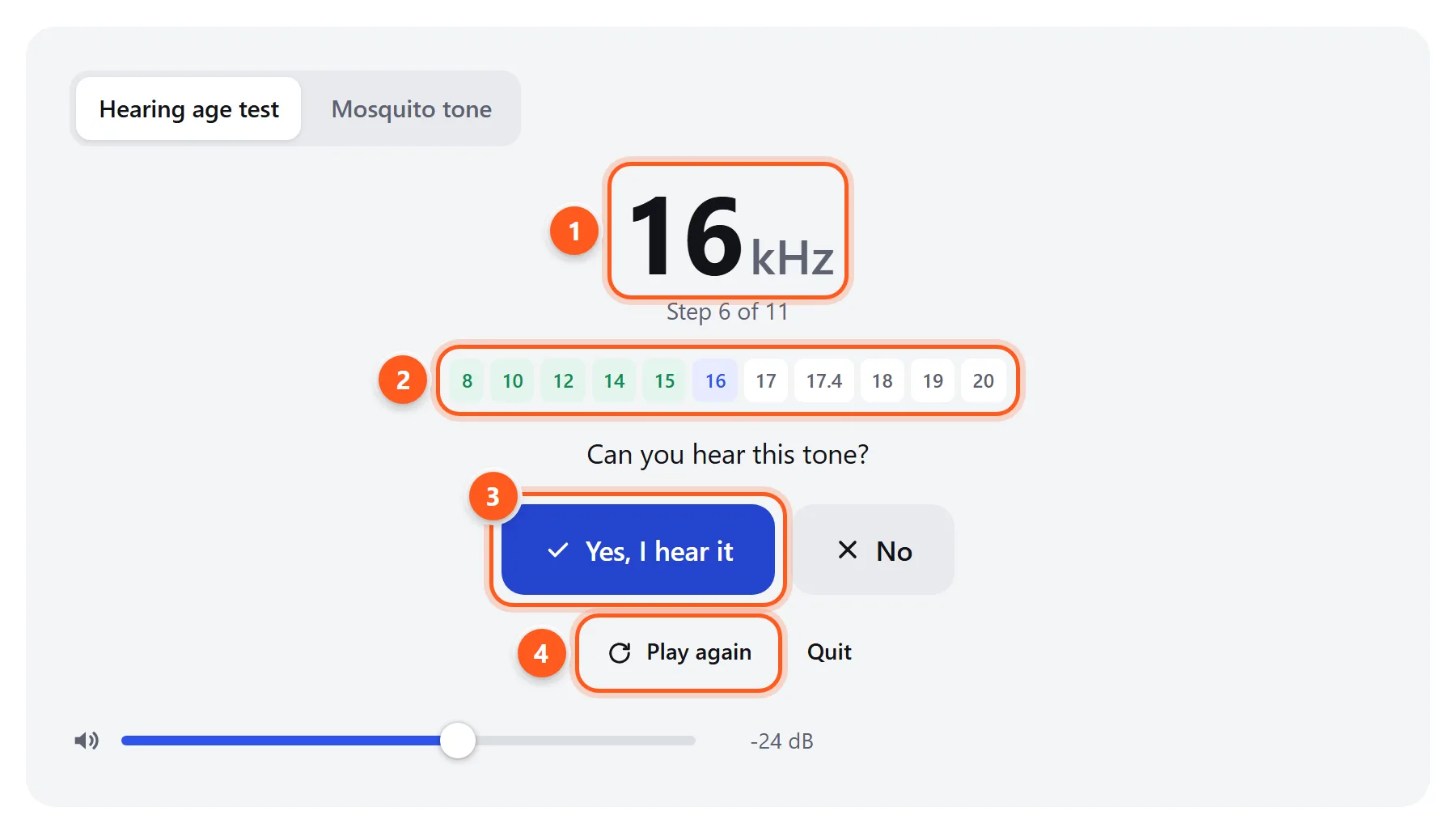
- The tone being played now.
- Your progress. Green steps you heard. The current step is highlighted.
- Answer honestly. Two steps in every test are silent, and saying “yes” to them is flagged in your result.
- Replay the tone if you missed it.
Hearing age by frequency
The table shows the highest frequency typical people in each age group can still hear. Press play to hear each one, starting with the low ones and only at a moderate volume.
| Frequency | Typically audible to | Listen |
|---|---|---|
| 8 kHz | Almost everyone | |
| 10 kHz | Under 60 | |
| 12 kHz | Under 50 | |
| 14 kHz | Under 49 | |
| 15 kHz | Under 40 | |
| 16 kHz | Under 30 | |
| 17.4 kHz | Under 24 (the mosquito tone) | |
| 19 kHz | Under 20 |
These are averages from popular hearing-age charts, not clinical norms. Upper hearing limits vary a lot between people of the same age: someone who has avoided loud noise can keep 16 kHz hearing well into middle age.
What is the mosquito tone?
The “Mosquito” is an anti-loitering device invented in Wales in 2005. It emits a pulsing 17.4 kHz tone that is irritating to teenagers and young adults but inaudible to most people over 25. Shops and train stations installed it to stop groups of young people from gathering. It’s controversial, and some countries have restricted it because it targets people by age and affects young children and people with sensitive hearing.
Teenagers soon turned the idea around. The mosquito ringtone, a high-pitched tone that their teachers couldn’t hear, spread quickly in 2006. You can play both versions in the Mosquito tone tab above and download them as WAV ringtones.
Hear the difference:
Why we lose high frequencies first
Inside the cochlea, sound is sorted by pitch along a coiled tube. High frequencies are picked up by hair cells right at its entrance, where every sound passes through first. These cells take the most wear from loud noise, and they also decline with age, medications and some illnesses. Hair cells don’t regrow, so the top of your hearing range slowly comes down: from around 20 kHz in childhood to 12–14 kHz in middle age, and lower later in life.
Losing hearing above 15 kHz makes no difference to understanding speech. The early warning sign that does matter is losing the 3–8 kHz range, where consonants like “s”, “f” and “th” live. That’s what a standard hearing test measures.
Is it your ears or your equipment?
If you can’t hear the high tones, the limit might be your gear:
- Laptop and phone speakers are tiny and often roll off sharply above 14–16 kHz.
- Bluetooth audio can cut the highest frequencies. The basic SBC codec and some AAC encoders filter out content above roughly 16–17 kHz, especially on a weak connection.
- Sample rate. Digital audio can only contain frequencies up to half its sample rate: 22.05 kHz at 44.1 kHz and 24 kHz at 48 kHz. This test skips any step your device can’t play.
- Audio “enhancements”, EQ apps and hearing-aid modes can boost or cut high frequencies. Turn them off for this test.
Use the frequency test to sweep the full range and see where your setup stops.