What speaker polarity means
A speaker makes sound by pushing its cone out and pulling it back in. When both speakers in a stereo pair receive the same signal, both cones should move out at the same moment. That’s correct, or in phase, polarity. If the positive and negative wires to one speaker are swapped, that speaker’s cone moves in while the other moves out. The two speakers then partly cancel each other, mostly in the bass, where the wavelengths are long enough to overlap in your room.
Polarity problems are common after you move speakers, replace cables, or install new car speakers. They don’t harm your equipment, but they make music sound thin and hollow, with a vague center image.
How this test works
The test plays the same signal through both speakers. One version is normal. In the other, the right channel is inverted, which mimics a reversed wire. If your speakers are wired correctly, the normal version sounds fuller and focused, and the inverted version thin and diffuse. If one speaker is already reversed, it’s the other way around, because inverting a reversed speaker makes the pair correct again.
The blind test hides which version is which and shuffles them every round. That matters: if you know which button is “correct”, you’ll tend to hear it as better. After three rounds, a consistent choice gives a clear verdict. The manual mode lets you switch freely between the two versions with three different signals:
- Bass noise (40–250 Hz): the most reliable. The difference in bass level is easy to hear.
- 80 Hz tone: a single bass note. Clearly louder when in phase.
- Pink noise: the full spectrum. Listen to the image: a tight point in the center when in phase, wide and vague when out of phase.
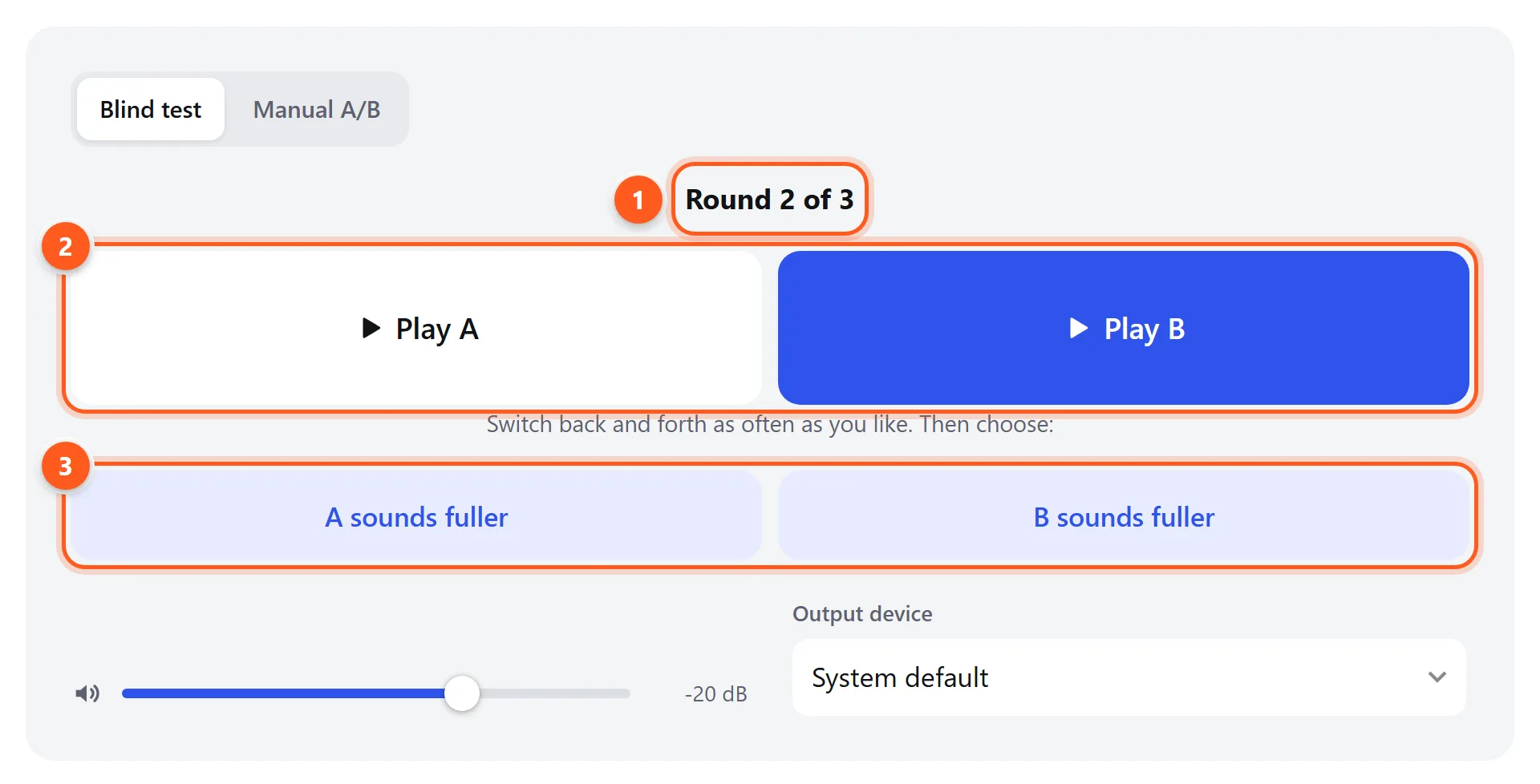
- Your progress through the 3 rounds.
- Switch between A and B as often as you like. Which one is inverted changes randomly every round.
- Pick the version with fuller bass and a more solid center. The buttons unlock once you’ve heard both.
How to fix reversed speaker polarity
- Turn off the amplifier or receiver.
- Check the amplifier end. Each speaker output has a red (+) and a black (−) terminal. Note which wire conductor goes to red for each channel.
- Identify the wire marking. Speaker wire usually has a ridge, stripe or printed text on one conductor, or one copper and one silver conductor. Follow that conductor to the speaker.
- Check the speaker end. The same marked conductor must go to the red (+) terminal on both speakers. If one speaker has it on black, swap the two wires on that speaker only.
- Run the blind test again to confirm.
With powered (active) speakers connected by a single cable per speaker, such as RCA or XLR, polarity can’t be swapped by mistake. If the test shows a problem there, check for a “phase” or “polarity” switch on the back of one speaker, or a phase-invert setting in your audio interface or DSP.
Testing car speaker polarity
Car speakers sit at different distances and angles, so listening tests are harder. Use the fader and balance controls to play only the two front speakers, then run the blind test from the center of the car. To check a single speaker directly, use the classic battery test:
- Disconnect both speaker wires from the speaker.
- Briefly touch the + terminal of a 9 V (or 1.5 V AA) battery to the speaker’s + terminal and the battery’s − to the speaker’s − terminal.
- Watch the cone. If it moves outward, the terminals are marked correctly. If it moves inward, the markings are reversed.
- Do the same with the wires coming from the head unit, using the battery test on a known-good speaker, or follow the wiring diagram for your car.
Don’t battery-test tweeters. They’re fragile, and most have a capacitor in line that blocks DC, so the cone won’t move anyway. Only touch the battery for a moment. Never hold it there.
Polarity vs. phase
People use the terms interchangeably, but they’re slightly different. Polarity is a simple flip of the signal: positive becomes negative at every frequency. That’s what a swapped wire does. Phase describes timing differences, which vary with frequency. For example, a subwoofer placed farther away than your main speakers arrives slightly late. That’s why subwoofers have a 0–180° phase control, which you can set with the subwoofer test. “Out of phase” speakers almost always means reversed polarity.